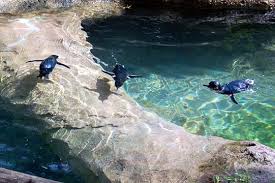
HI Everybody! Now I want to tell you about the smallest penguin's species in the world. This penguin called Fairy Penguin or Little Blue Penguin.
Eudyptula minor or also known as fairy penguin is the smallest
species of penguins in the world. It grows to an average of 33 cm (13 in) in
height and 43 cm (17 in) in length.
Fairy Penguins
The head
and upper parts are blue in colour, with slate-grey ear coverts fading to white
underneath, from the chin to the belly. Their flippers are blue in colour. The
dark grey-black beak is 3–4 cm long, the irises pale silvery- or
bluish-grey or hazel, and the feet pink above with black soles and webbing. An
immature individual will have a shorter bill and lighter upperparts.
Like most seabirds, they have a long lifespan. The average for the species is 6.5 years, but in some cases tyeh can life until 25 years.
It is found on the coastlines of southern Australia and New Zealand, with possible records from Chilie. In Australia, they are often called fairy penguins because of their small size. In New Zealand, they are more commonly known as little blue penguins or blue penguins.
Taxonomy for this species
Little penguins are spend the largest part of their day swimming and foraging at sea. During the breeding and chick rearing seasons, little penguins will leave their nest at sunrise, forage for food throughout the day and return to their nests just after dusk.

Today, the little penguin populations have been declining with the increasingly threat from non-native carnivores. Beside that, many things that threated the Little Penguins, such as culling,human development, human interference, interaction with fishing, pollution, and predation.
The impacts of human development to the little penguin include collisions with vehicles, burning and clearing of vegetation, and housing development. Little penguin also threated by human cruelty, some kicked, some thrown of a cliff and shot at. Of course Little Penguin also threats by predators like cats, dogs, foxes, rats, large reptiles, ferrets, and stoats.
Like most seabirds, they have a long lifespan. The average for the species is 6.5 years, but in some cases tyeh can life until 25 years.
It is found on the coastlines of southern Australia and New Zealand, with possible records from Chilie. In Australia, they are often called fairy penguins because of their small size. In New Zealand, they are more commonly known as little blue penguins or blue penguins.
Taxonomy for this species
Kingdom:
|
Animalia
|
Phylum:
|
Chordata
|
Class:
|
Aves
|
Order:
|
Sphenisciformes
|
Family:
|
Sphenischidae
|
Genus:
|
Eudyptula
|
Species:
|
E. minor
|
Little penguins are spend the largest part of their day swimming and foraging at sea. During the breeding and chick rearing seasons, little penguins will leave their nest at sunrise, forage for food throughout the day and return to their nests just after dusk.
Little penguins preen their feathers to
keep them waterproof. They do this by rubbing a tiny drop of oil into every
feather from a special gland above the tail.
These birds feed by hunting small clupeoid
fish, cephalopods and crustaceans,
for which they travel and dive quite extensively. They are generally inshore
feeders. 50% of their dives go no deeper than 2 m and the mean diving time
is 21 seconds. Yet, they are able to dive as deep as 20 m and remained
submerged as long as 60 seconds. Little penguins play an important role in the
ecosystem as not only a predator to parasites but also as a host. Other than that, Fairy Penguins also lives in colony.
Today, the little penguin populations have been declining with the increasingly threat from non-native carnivores. Beside that, many things that threated the Little Penguins, such as culling,human development, human interference, interaction with fishing, pollution, and predation.
The impacts of human development to the little penguin include collisions with vehicles, burning and clearing of vegetation, and housing development. Little penguin also threated by human cruelty, some kicked, some thrown of a cliff and shot at. Of course Little Penguin also threats by predators like cats, dogs, foxes, rats, large reptiles, ferrets, and stoats.
Resources :
http://news.nationalgeographic.com/2016/02/160224-penguins-animals-science-australia-global-warming/
https://a-z-animals.com/animals/little-penguin/
Questions
1. How many eggs are produced in one reproduction ?
a. 1 or 2
b. 5 or 6
c. 9 or 10
d. 15 or 16
e. 3 or 4
2. What is the scientific name of this animal ?
a. Eudyptes chrysocome
b. Eudyptula sclayeri
c. Eudyptula minor
d. Eudyptula robustus
e. Megadyptes antipodes
3. What is part of this species body that distinguish between male and female ?
a. Fur
b. Feet
c. Eyes
d. Beak
e. WIngs
4. This species has 6 subspecies in belows, exept...
a. E. minor minor
b. E. austaliania
c. E. albosignata
d. E. iridalei
e. E. novaeholandia
5. At what age the female little penguin will mature ?
a. 2 years old
b. 3 years old
c. 4 years old
d. 5 years old
e. 6 years old
Questions
1. How many eggs are produced in one reproduction ?
a. 1 or 2
b. 5 or 6
c. 9 or 10
d. 15 or 16
e. 3 or 4
2. What is the scientific name of this animal ?
a. Eudyptes chrysocome
b. Eudyptula sclayeri
c. Eudyptula minor
d. Eudyptula robustus
e. Megadyptes antipodes
3. What is part of this species body that distinguish between male and female ?
a. Fur
b. Feet
c. Eyes
d. Beak
e. WIngs
4. This species has 6 subspecies in belows, exept...
a. E. minor minor
b. E. austaliania
c. E. albosignata
d. E. iridalei
e. E. novaeholandia
5. At what age the female little penguin will mature ?
a. 2 years old
b. 3 years old
c. 4 years old
d. 5 years old
e. 6 years old
Komentar
Posting Komentar